
A Subsidiary Liability Claim Has Already Been Filed Against You
An insolvency administrator, creditor or other applicant is seeking to make you subsidiarily liable for the company’s debts.
DEFENSE OF DIRECTORS AND OWNERS
We defend directors, owners, beneficiaries and other controlling persons when bankruptcy proceedings include claims seeking to make them personally liable for the company’s debts. We analyze the application, the debtor’s documents, transactions and the causes of insolvency, prepare objections and represent the defense in Russian commercial courts.
WHEN DEFENSE IS NEEDED
An insolvency administrator, creditor or other applicant is seeking to make you subsidiarily liable for the company’s debts.
Your authority has already ended, but actions taken while you managed the debtor have become the subject of a bankruptcy dispute.
The applicant alleges that you effectively determined the company’s actions and should be liable for its obligations.
It is necessary to determine whether you actually had the ability to direct the debtor’s actions and what evidence the applicant relies on.
The applicant argues that the director should have filed the debtor’s bankruptcy petition with the Russian commercial court earlier.
Business decisions, payments, transfers of property or transactions completed before bankruptcy are being challenged.
The applicant relies on missing, incomplete or inaccurate debtor records and links this to the inability to satisfy creditor claims.
The court ruling, the deadline and the grounds for appeal or cassation review need to be assessed.
Nikolay NemkovManaging Partner, Konsultant Law Firm
Managing Partner’s Commentary
Why the defense should not begin with a general statement such as “I am not at fault,” but with a review of the specific legal grounds of the claim, the person’s role in the company, the causes of bankruptcy and the evidence relating to each disputed episode.
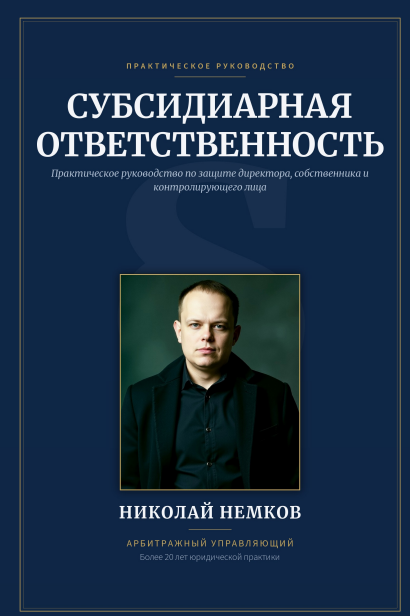
Book by Nikolay Nemkov
Original Russian title: «Субсидиарная ответственность»
Nikolay Nemkov is the author of a book on subsidiary liability for company directors, business owners and controlling persons. The book explains the risk of personal liability for company debts and the mechanism of subsidiary liability under Russian law.
Managing Partner, Konsultant Law Firm
The book is in Russian. The English title is a translation for this page.
Both links open in a new tab.
Facing subsidiary liability risk in Russia?
Discuss Your SituationDEFENSE STRATEGY
In a subsidiary liability dispute, it is essential to identify the specific legal basis on which the applicant seeks to recover the company’s debts from a particular individual. The status of a controlling person, the alleged acts or omissions, causation, fault, statutory presumptions and the amount of potential liability must each be reviewed separately.
We examine the basis for alleging that the defendant could direct the debtor’s actions or make decisions binding on the company.
We identify the specific acts or omissions alleged by the applicant and the legal provision on which the claim relies.
We assess whether the evidence actually establishes that the alleged conduct caused the inability to satisfy creditor claims in full.
We analyze the applicant’s calculation and the legal basis used to determine the potential amount of liability.
We study the subsidiary liability application, bankruptcy court rulings, the insolvency administrator’s reports and the documents relied upon by the applicant.
We analyze formal authority, actual influence over the debtor’s operations and the circumstances the applicant relies on to establish control.
We review the company’s financial position, significant transactions, cash flows and circumstances that may have contributed to the bankruptcy.
We prepare the response and objections, organize the documents and determine which facts need to be established in court.
We participate in the hearing of the claim, present evidence, challenge the applicant’s arguments and file the necessary motions.
Where legally justified, we prepare an appeal or cassation complaint and represent the client during review of the court ruling.
The firm has been practicing since 2007. We handle litigation and complex legal matters for businesses in Krasnoyarsk, Moscow and other regions of Russia.
The bankruptcy of a legal entity does not automatically mean that its debts can be recovered from its director, owner or beneficiary. The dispute must establish the statutory grounds for imposing liability on the particular person.
At the same time, Russian bankruptcy law contains special presumptions and rules on the burden of proof. The defense therefore needs to address the specific allegations and evidence relied upon for each asserted ground, rather than respond to an abstract accusation.
The subsidiary liability application, bankruptcy court rulings and the documents on which the applicant relies.
We determine why the person is alleged to be controlling the debtor and what acts or omissions are attributed to them.
We identify documents and circumstances showing the defendant’s actual role, the economic rationale of business decisions and the causes of the company’s financial condition.
We prepare objections, evidence and an action plan based on the current stage of the court dispute.
MANAGING PARTNER

Managing Partner, Konsultant Law Firm
More than 20 years of practice in complex property and corporate disputes. Practicing insolvency practitioner.
Subsidiary Liability in Practice
Practical answers for directors, owners and controlling persons facing the risk of subsidiary liability in Russian bankruptcy proceedings.
Controlling persons of a debtor may be held liable where the legal grounds established by law are proven.
Such persons may include directors, shareholders, beneficiaries and other individuals who had the ability to determine the debtor’s actions.
The mere fact that a person was a company director or shareholder does not automatically result in liability. Specific circumstances, including the person’s actions or omissions, causation and resulting consequences must be established.
As a general rule, a legal entity is responsible for its own obligations.
However, in cases established by law, a director or another controlling person may be held liable under subsidiary liability rules.
This requires proving the legal grounds for liability and cannot be based only on the fact that a person held the position of director.
The defense strategy depends on the specific circumstances of the case and the arguments presented by the claimant.
It is necessary to analyse the legal grounds for liability, evidence, the actions of the controlling person and the causal connection between those actions and the alleged consequences.
Documents proving proper conduct, lack of actual control over the situation or absence of legal grounds for liability may be important.
The risk may arise in bankruptcy proceedings where there are grounds to argue that the actions of controlling persons affected the debtor’s inability to satisfy creditors.
Risk assessment requires analysis of the company’s financial condition, management actions, transactions, documents and bankruptcy circumstances.
Yes. Before a dispute arises, it is possible to analyse documents, ownership structure, company management and potential risks.
Such an assessment helps identify problematic situations and determine possible protective measures.
Subsidiary liability issues are most commonly considered within bankruptcy proceedings.
Such proceedings examine the reasons why creditors could not be satisfied and the role of controlling persons in creating or contributing to those circumstances.
Subsidiary liability disputes require analysis of extensive documents and bankruptcy circumstances.
It is important to assess not only the claimant’s arguments but also the evidence, legal grounds for liability and possible defense strategies.
Describe your role in the company, who is seeking to make you subsidiarily liable and the current stage of the case. If an application has already been filed, include the bankruptcy case number and the date of the next court hearing.