
A counterparty received goods or services but did not pay
Recovery of debts arising from supply, construction, service and other contractual obligations.
Business Disputes & Protection
We help recover debts arising from contracts, supplies, services and other obligations — from assessing recovery prospects to court proceedings and actually obtaining payment from the debtor.
We work across Russia. We represent creditors in court and at the enforcement stage.
Recovery of debts arising from supply, construction, service and other contractual obligations.
We review the legal basis, the amount owed and the documents confirming the obligation.
We document the debtor’s position and assess how to move the negotiations into a formal legal process.
We review the transfer of funds, repayment terms and evidence relating to the loan agreement.
We obtain the enforcement document and work toward actual enforcement of the judgment.
We assess whether interim measures and attachment of the debtor’s assets are appropriate.
We analyze the evidence, the debtor’s position and the prospects of actual recovery.
We calculate contractual penalties, interest for the use of another party’s funds and recoverable legal costs.
Nikolay NemkovManaging Partner, Konsultant Law Firm
What should be checked before starting recovery
Our Approach
A court judgment does not return the money by itself. Before filing a claim, we assess not only the legal prospects of the dispute but also where the awarded amount can actually be recovered from: the legal basis, evidence, the debtor’s position and its assets.
Court Practice
Bury LLC (ООО «Бурый») sought to reopen the judgment of 5 October 2022 ordering it to pay sole proprietor Aleksey Boykov (ИП Бойков Алексей Васильевич) RUB 3,938,309.80. On 1 November 2024, the court rejected the application. The earlier award was not set aside by this ruling.
The management company made partial payments for lift maintenance and repairs but did not settle the outstanding balance. The court ordered ООО УК «Содружество-Сервис» to pay ООО «Ритол» RUB 1,077,311.80 in principal debt and RUB 50,888 in court fee reimbursement, a total of RUB 1,128,199.80.
КПК «Совет» failed to return the client’s personal savings after the agreement expired. A formal demand produced no result. The court awarded the principal amount, contractual compensation and interest for late payment — RUB 546,433.28 in total.
The initial court decisions were set aside on cassation and the case was remitted for a new hearing. The client’s claims were increased to RUB 2.6 million and granted. The final result was upheld by the higher courts. The client actually received the awarded money.
In this debt recovery matter, the creditor’s claims of over RUB 15 million were confirmed.
In a debt recovery case, we obtained a judgment ordering the debtor to pay our client RUB 6.8 million.
View All Cases
The firm has been practicing since 2007. We handle litigation and complex legal matters for businesses in Krasnoyarsk, Moscow and other regions of Russia.
What Our Clients Say
Video testimonials, client letters and ratings on independent platforms.
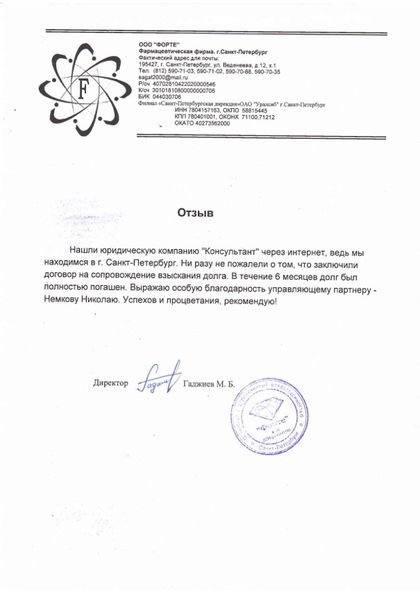
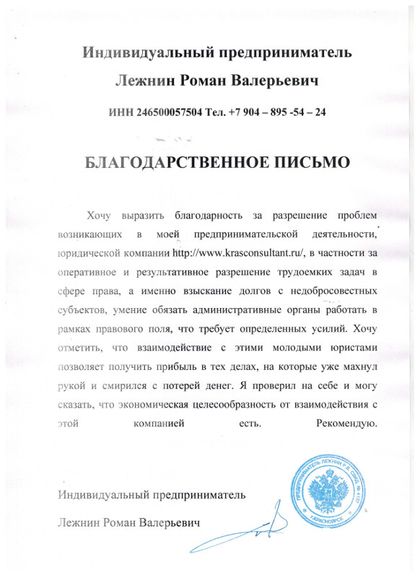
Debt Recovery and Resolution of Complex Legal Issues
Related Practice: Debt Recovery
For a creditor, winning the dispute is not enough; what matters is whether the awarded amount can actually be recovered. We therefore assess recovery prospects not only from the contract and evidence, but also from the debtor’s position and the likely enforcement process.
Our task is not merely to obtain a court judgment, but to determine where the money can actually be recovered from.
Client Testimonial
Elena describes the recovery of a debt exceeding RUB 1.5 million. After the court judgment was obtained, the work continued during enforcement proceedings and, according to the client, the money was ultimately recovered from the debtor.
Debt Recovery Client
Debt Recovery Dispute
Elena describes the recovery of a debt exceeding RUB 1.5 million, including continued work during enforcement proceedings.
“The debt I had considered hopeless was ultimately recovered.”
Related Practice: Debt Recovery
Video testimonial
Ilya Ermilov
Client of Nikolay Nemkov
Moscow
Debt recovery under a writ of execution
Ilya lives in Moscow and describes recovering a debt arising from a case in Krasnoyarsk. He already had a writ of execution but had been unable to collect the money for about six months. According to Ilya, after he contacted Nikolay Nemkov, the money was recovered within a month and a half.
Video in Russian. The description is provided in English.
Client Testimonial
Konstantin Arkhipenko
Konstantin Arkhipenko has been a client of Nikolay Nemkov for more than 10 years.
“When Nikolay was involved, there was a real opportunity to achieve a result and recover money from debtors.”
Konstantin Arkhipenko has known Nikolay Nemkov for more than 10 years. During that time, he has sought legal assistance on different matters, including employment disputes and the recovery of money from debtors.
For Konstantin, however, a long-term relationship with a lawyer is not limited to court proceedings. In his testimonial, he specifically recalls situations in which Nikolay Nemkov advised him not to start litigation.
This approach is fundamental to our work: a lawyer’s task is not to take every conflict to court, but first to determine which option genuinely serves the client’s interests.
Before proceedings begin, it is important to assess the evidence, the debtor’s financial position, the prospects of actual recovery and whether the legal costs make economic sense.
If litigation does not give the client a reasonable prospect of a useful result, that should be understood before time and money are spent.
“The entire process was clear, structured and easy to understand.”Discuss Debt Recovery
Who Works on the Matter

Managing Partner, Konsultant Law Firm
More than 20 years of practice in complex property and corporate disputes. Practicing insolvency practitioner.
Debt Recovery — Key Points
Practical answers to questions that arise before court proceedings, during the dispute and at the enforcement stage.
In some cases, yes. The absence of a single signed contract does not necessarily mean that no enforceable obligation exists.
A Russian court may assess the evidence as a whole, including acceptance documents, invoices, payment records, business and electronic correspondence, and documents showing that the parties actually performed their obligations.
Written form is important for transactions between legal entities. As a general rule, failure to comply with simple written form restricts reliance on witness testimony but does not exclude written and other evidence. Certain types of transactions may be subject to special statutory consequences, so the legal basis of the debt and the available evidence must be assessed in the circumstances of the particular case.
Legal basis: Articles 161–162 of the Civil Code of the Russian Federation and Article 75 of the Russian Arbitrazh Procedure Code.
The first question is not only whether a court judgment can be obtained, but whether that judgment can actually be enforced.
Before and during court proceedings, it is important to assess the debtor’s known assets, existing court and enforcement proceedings, signs of financial distress and other circumstances that may affect recovery.
Where there is evidence that failure to take urgent measures may make enforcement of a future judgment difficult or impossible, interim measures may be requested. The Russian commercial court decides whether such measures are justified and proportionate in the circumstances of the case.
After an enforcement document is obtained, recovery may continue through enforcement proceedings. Russian law provides, among other things, for attachment of funds and property and, where statutory conditions are met, searches for the debtor’s property.
Legal basis: Articles 90–91 of the Russian Arbitrazh Procedure Code and Articles 64–65 of Federal Law No. 229-FZ on Enforcement Proceedings.
As a general rule, the limitation period is three years, but it is important to determine correctly when that period began to run.
Where an obligation has a specific performance deadline, the limitation period generally begins after that deadline expires. In other situations, the starting point depends on the nature of the obligation and the circumstances in which the right was breached.
Actions by the debtor that amount to acknowledgment of the debt may interrupt the limitation period, after which the period begins to run again.
For this reason, the three-year period should not automatically be calculated from the date of the contract, invoice or first correspondence. It must be calculated for the particular obligation.
Legal basis: Articles 196, 200 and 203 of the Civil Code of the Russian Federation.
In this situation, it is important not to focus only on preparing the claim. Evidence indicating a risk of loss or disposal of assets should be identified and preserved as early as possible.
If failure to adopt interim measures may make enforcement of a future judgment difficult or impossible, an application for interim relief may be made in Russian commercial court proceedings. Such measures may include attachment of funds or other property and restrictions on certain actions.
The court does not grant these measures automatically. The applicant must justify why they are necessary, and the measures must be connected with the dispute and proportionate to the claim.
If property has already been transferred to other persons, the possibility of challenging the relevant transactions depends on the legal grounds, timing and circumstances, including whether the debtor is subject to bankruptcy proceedings.
Legal basis: Articles 90–91 of the Russian Arbitrazh Procedure Code.
Yes, where there is an enforceable obligation and it can be established by admissible evidence.
Depending on the circumstances, evidence may include an agreement or written acknowledgment of debt, bank transfers, payment records, correspondence and other materials that establish the legal basis and amount of the debt.
The applicable court procedure and jurisdiction depend on the nature of the dispute and the status of the parties. Before filing a claim, the legal basis of the demand, the available evidence and the court with jurisdiction over the dispute should therefore be determined.
A court judgment by itself does not mean that the creditor has actually received the money.
After the judgment becomes enforceable and an enforcement document is obtained, the enforcement stage begins. In enforcement proceedings, a bailiff may take the enforcement actions provided by law, including obtaining information about the debtor’s property, attaching funds and property and, where the statutory conditions are met, searching for the debtor’s property.
For this reason, an effective debt recovery strategy should take enforcement into account before the claim is filed. The question is not only how to obtain a judgment, but also which assets may realistically be used to satisfy it.
Legal basis: Articles 64–65 of Federal Law No. 229-FZ on Enforcement Proceedings.
Depending on the legal basis of the obligation, a creditor may be entitled to claim not only the principal debt but also liability for delay provided by contract or law.
For a delayed monetary obligation, Article 395 of the Civil Code of the Russian Federation provides for interest on the outstanding amount unless a different interest rate is established by law or contract.
Where a contract provides for a penalty for breach of a monetary obligation, whether that penalty may be claimed together with Article 395 interest depends on the applicable law and the terms of the contract. In circumstances provided by law, a court may also reduce a contractual penalty if it is manifestly disproportionate to the consequences of the breach.
The principal debt, contractual penalty and statutory interest should therefore be calculated separately and the legal basis for each part of the claim should be checked.
Legal basis: Articles 333 and 395 of the Civil Code of the Russian Federation.
Tell us who owes you money, how much is owed, how the debt arose and which documents confirm the obligation.
Send us the key documents. We will determine where the debt assessment should begin.